The post Factors Affecting App Development Cost appeared first on Adrixus.
]]>So, here we are discussing the factors that might affect the pricing of your new application development.
Business requirements
The first thing first! The core factor affecting you to determine the price of your next application will be to prioritize the business requirements. When you say business requirements, you should understand that things like when you want your application to be ready, do you have a team of in-house developers ready, are you going ahead with the offshore mobile application development and more.
With the expert application development team and project managers, you will be able to get the most bang for your buck proposition. There are various natures of an application depending on the usage of the user. For instance, an application that has cloud functionality for uploads and computing, scalable e-commerce applications, apps with online portals and communities – as per nature the development cost would go up and low.
Based on the platform
A cross-platform capable hybrid application is always good for increasing your market share. But, it might become complex and costly to build an application that can work on both major platforms, ie iOS and Android at the same time.
Native applications might end up becoming cheaper for someone, but that could also cut down your ability to increase the market share from the next big platform and could limit your ability to reach a broader audience. So, select your platform and you would be able to see where your planning goes for the new application development.
Features, functionalities and UX
Where database-intensive applications need a lot of API collaboration, the complexity of the technical side would increase the cost. Where in case of an e-commerce application or gaming application, graphics, UI, UX and traffic would matter the most – here you should consider improving user experience more than anything else in the application.
A normal note making the application would not need location functionality or a text-heavy news site would not need a video player embedded in it. Chose your features accordingly to save both time and money on development!
Scalability and maintenance of the application
Once you make the application live, you would need to keep adding more features and scale it as your user base and marketing needs start growing. Starting from normal user logins to sending custom notifications and adding trackers like cookies and machine learning tools would take a lot of time, research and resources to go behind the scenes.
Saying that you should always consider starting your application development by developing an MVP initially to save cost and check the viability of your idea!
Testing and connectivity
Quality control and testing the usability of your application plays a major role in building a successful mobile application. As an application would get access to a lot of APIs and work with multiple analytics and marketing tools to help the development team.
When it comes to testing the application, many use third-party testing teams or even ask their users to test the platform before making it live for the masses. Either way, you would need to invest some time and resources to get the best version of your applications.
Also, all the OS and platforms do not work in the same way. For example, Apple and Google both imposes a lot of restrictions and rules for developers to submit their applications on their platforms. So, to pass those parameters and creating a perfect application for users.
Summery
The cost of developing your new application will keep varying from changing the launch timelines to even investing time and resources into marketing.
So, if you are planning to launch and develop a new application for the market – make sure to strategise it and apply the best development practices and project management ideas to minimise the costs.
The post Factors Affecting App Development Cost appeared first on Adrixus.
]]>The post How to Select the Right Tech Stack for Your Next Digital Product Development appeared first on Adrixus.
]]>
So, how do you select the right technology stack for the digital product you want to build for the masses? Let’s find out in the blog!
What is a tech stack?
A tech stack is an ecosystem made of technologies that help you develop your product. Technologies like front-end & back-end languages, databases, modules, and tools help you build the product come under your product development tech stack.
Here are some of the examples of technologies that are used for product development.
Front-end development: Angular, ReactJS, JQuery, JavaScript, Bootstrap and more
Back-end development: .Net MVC, Codeigniter, Laravel, NodeJS, Python and more
What are the technologies to chose from?
How to select the right tech stack for your next product?
Selecting the right technology stack is very important. If you fail to make the right decision, you would face a loss of resources invested behind the development, good UI/UX, and even revenue loss from your users.
So, here are the top tips to select the right tech stack for your next digital product.
Ignore peer pressure
Most startups and organizations think that they can also start reverse engineering their peers and competitors and start making their products just how they are building using the same technology stack. But, even if you are building a similar product or something else, directly considering that the peers’ technology will fill your demand is the wrong option.
For your mobile app or web app, decide what will help you the most. And that is where our next point helps!
Select your product category and scalability
Selecting a tech stack that will help you scale your app in the future is crucial. When you start building a new product, it will probably be light and agile in the initial stages. But, as soon as you start scaling it, a lot of internal and external APIs join the process and the complexity starts increasing day by day.
Thus, by looking at the scope of your project make your tech stack selections. Also, product development is a long process. That means a lot of new development, marketing and the administrative team would get bigger eventually. Adding new modules in the process also is a challenge, thus a proper tech stack is always helpful!
Do not forget the marketing requirements
As we know that the entrepreneurs and startup founders do make sure that they do not end up investing all their resources into building the product before finding its fit in the market. Thus, people do start with an MVP for their products.
While building the MVP, most of the founders tend to start doing marketing and promotions for their product. And for that, going as early as possible in the market is required! So, without investing a lot of resources and time, balancing between the best tech stack could help! As, creating multiple landing pages and other functionalities, a faster and efficient technology would help.
The budget factors
The budget plays its role in selecting the right technology for your product. If you go ahead with Blockchain-based development or new technologies like voice-based applications and machine learning algorithms; the development costs and resources to run the project would start rising.
While new-generation technologies also make the product better and more useful, however planning when to implement them also makes a lot of difference on ROI for that product. While selecting and hiring the developers for your team, newer technologies might cost you more and research might end up eating a lot of time for you. So, go ahead with a tech stack that balances both time and efforts for you and plan your budget accordingly.
Take your experience into consideration
With the evolution of time and technologies, people do think that adopting new technologies would help them grow better. But, sometimes, sticking to basics would help you in the long run.
Make sure you choose the technologies where you can troubleshoot the product’s problems or have done core research upon. Otherwise, while developing the product, the technology and its solutions would eat up a lot of time of yours in it.
Cybersecurity
While scaling up the product and consumer base, your application will attract a lot of threat from hackers and even scripts on server or client sides. So, a tech stack that is safe from such threats will help you save your and your users’ data. Every technology does not come with a layer of security, so select your tech stack wisely.
These key points will help you find the suitable tech stack for your next web or mobile application and digital product. You can also work with subject matter experts or consultants to get help in choosing the right tech stack for your next project.
If you have an idea in your mind, visit our contact page to discuss it with us, now!
The post How to Select the Right Tech Stack for Your Next Digital Product Development appeared first on Adrixus.
]]>The post Website vs Web-App: A Complete Guide for Your Online Business appeared first on Adrixus.
]]>
For example, the social media sites we use daily are web applications and the NEWS portals or blogs we read (well most of them) are websites.
So, are every website and web applications still different or they both are the same? Let’s understand!
What is a website?
A website is an online digital property that contains information in the form of text, picture, videos, voices and other forms of content.
A digital property where you want to show or market your work is a website. For example, the blog you are reading right now, a portfolio website that you build to showcase your work, the company’s corporate website for marketing purposes or simple one-pagers where you can visit and access the content.
But well, there is a small difference between accessing and interacting with the content. Yes, you can interact with the websites as well, but the functionalities and abilities are lesser than what you can do with the web app.
What is a web application?
A web application is an app where users can interact and use various functionalities. These apps are generally hosted on servers and can be accessed via a browser on the user end. For example, e-commerce websites let you see the products and also helps you to submit your order with a lot of functionalities built around it!
Similarly, social media applications also let you create content, follow or even set up payment options in your account. Compared to a website, web applications can do many things and let people engage with the content online.
Which one should your business adopt?
According to your business use-case, you can decide which one suits you best for your business and growth.
Requirement
If your business demands an application that just needs to showcase your business portfolio and do marketing activities for your brand, then a website is better for your usages.
If your web property needs to have complex features like having user signups, sending a lot of intersecting marketing messages and notifications, keeping users engaged, and letting them manage their profile while intersecting with others on the platform, your choice should be a web application.
Marketing needs
Web applications are generally complex and a lot of things are managed via back-end software and automation tools. Thus, marketing and promoting your web application is easy, user tracking would help you to gain a better market share.
Integrations
Compared to a simple website, a web application would be able to integrate with multiple APIs and other tools to make the user experience better. For a website, collecting user data and basic information might help, but requirements would grow in the case of a full-fledged application. So, according to your requirements, make the right decision.
So, to summarise this question about which one should your business select from a website and a web application – if you have simple usages where a lot of data and collaboration is not needed, go with a website.
If you want to make a complex thing that runs with precision, go ahead with the web application. If you have a business idea in mind and want to take consulting, contact us and get a technical solution!
The post Website vs Web-App: A Complete Guide for Your Online Business appeared first on Adrixus.
]]>The post What is Blockchain as a Service? | BaaS Guide appeared first on Adrixus.
]]>
With the BaaS model, organizations allow their users (or other companies) to host their blockchain applications, run smart contracts and other blockchain-based services on their cloud-based blockchain infrastructure.
The inception of such a BaaS model is a significant leap in the technology community. It does promise the accelerated development of blockchain-based projects and helps smaller companies and developers build their blockchain projects without investing a whole lot of money into building infrastructure which can run blockchain and building blockchain programs from scratch.
Read more: Blockchain use cases in real-world!
When a blockchain-based product gets deployed into the system, all the connected nodes need to stay connected. On top of that, the infrastructure running the services also needs maintenance and set up costs to keep it running. For hassle-free operation, going with SaaS like a model. Plus, keeping the servers safe from the external hacking activity is also a huge issue and requires dedicated resources to keep it safe.
Microsoft, Amazon, R3, SAP, Alibaba clouds and more are offering platforms for deploying your Blockchain-based applications.
For choosing a good BaaS platform, you need to keep some of the things in the mind are cost-reduction, data-security, scalability and data flow. With proper selection of BaaS platform, your deployment will become faster and better.
So, in a nutshell, Blockchain as a Service would help to deploy and develop better blockchain-based applications and scalable products to even smaller startups.
The post What is Blockchain as a Service? | BaaS Guide appeared first on Adrixus.
]]>The post White label apps, the Good and the Bad! appeared first on Adrixus.
]]>What is a white label application?
In simple terms, white-label applications can be explained as developing a single purpose build application and then replicating it with minor design changes to suit the demand of other customers or businesses.
White labelling can also be understood by a company using an existing company’s application framework to develop its re-badge concept. It allows that company to use an established application in the market and not stress around with developing a new product from scratch. Letting them focus on market penetration and scaling the business.
It’s not necessary though that the white label application is useful for small businesses or requirements only. Even the B2B applications can get the most ROI out of their white label application if they can find a proper fit with their requirements.
For brands who have achieved a good reputation and market penetration in the market would enjoy a lot of share increment by using a white label application on their side.
What are the Pros and Cons of using a white label application?
While the white label applications sound simple and cheap solution to chose for your business requirements, selecting criteria can go beyond general thinking. Let’s understand what are the pros and cons of using or providing a white label solution and should your business opt for one?
Pros of using white label applications
Cost-effectiveness
As the white label solution deals with an already existing application and its code, the initial setup cost would be very minimal. Also, the white label application provider would not need to assign more resources to replicate and rebrand the application. Thus, the overall cost of resources would also go down, making a win-win situation for both seller and consumer.
Ease of usage
As the customers are already aware of the overall UI of similar applications they use, the learning curve would be easy for them. While an entirely new concept would be difficult to implement and make users go through an entirely new experience. White label solutions would make it easy for them and help companies to grow faster.
Faster growth
As the white label solution would be cheaper, the sellers would be able to get more customers with ease and the buyers would be able to invest more money in the improvement of their business processes.
Not only pricing, as it is a faster solution compared to the customized application, but buyers can also invest their valuable time into doing marketing activities for their company and products.
Access to innovation
As the white label applications are developed by sellers who are looking forward to improving their applications and building better products, the buyers would be able to gain the benefit of improved features and updates on the application.
With feature updates, the overall updates will make the application more secure and tamper-proof for attackers. Which is an added benefit for the buyer.
Cons of using white-label applications
Uniqueness
As the white label applications are derived from existing applications and its design; many times brands face issues while getting their applications up on PlayStore and AppStore. As the design and content updates are minimal in front of the already existing applications, it becomes problematic for them.
Availability of customization
Well, with the white label option, the scope of customization is limited. But, with respect to the business workflow and requirements of a specific audience, the seller can customize things that are important to the buyer.
All the standard features and updates would come with a white-label application, though adding customization might cost more and eat more time, making it a difficult solution for everyone. Even the technological scope goes down compared to a customized solution for your brand.
Scalability
Whitelabel applications are aimed to work on specific purposes and platforms only. Only a few percentages of applications can work across platforms. Which makes the scalability for a business limited.
The potential risk of liability
When brands give out the white label application to their customers, it involves a huge risk of backlash. If any customer is not happy with the overall UI and design of the application or the application has bugs involved, the brand would not be able to manage or do changes in their application. The entire process of bug solving from the seller would start and it could or could not make its way to the aimed end user.
So, choosing a white label solution can come with a lot of excitement of challenges for a brand. Make your smart decision and jump into white labelling space.
Make sure you do not end up choosing a solution provider who does not give you proper support for your application and updates for the same. Otherwise, the customers would seek new updates and new features, but your brand would end up keeping the same application without any changes, making them switch brands for no reason.
The post White label apps, the Good and the Bad! appeared first on Adrixus.
]]>The post Blockchain vs Traditional Database appeared first on Adrixus.
]]>
Let’s figure out the core difference between database and Blockchain in this blog.
What is a traditional database?
A traditional database is a client-server network architecture, where users can store and modify data. A traditional database is a centralized server with control given to a single authority. Data can be stored, modified and even deleted from a traditional database.
What is blockchain?
Compared to a traditional database, Blockchain is a decentralized and temper proof ledger. All the participating nodes can enter data in the Blockchain.
As the name suggests, blockchain is the collaboration of blocks and chains. When a new data makes its way to the system, a new block is created with data, changes and timestamps. That is interconnected with the previous blocks and would get connected with upcoming blocks, thus a chain gets created. And this entire system is known as Blockchain.
To change any data in the system, the majority of the nodes have to be in consensus. Unlike a traditional database, modifications and data removal is not easily possible.
Blockchain vs Traditional Database: a detailed comparison
As we saw that the definitions and usage of the Blockchain and traditional database is different. Let’s dive a bit deeper and understand how both are different from one another in terms of functionality and technology.
Architecture
The database being a client/server architecture is reliable and suitable for small, medium and large enterprises. Centralized control is given to the administrator to manage and update the entire database. No consensus algorithm is needed nor the complex setup is required. Client-server communication happens with a secured channel.
Blockchain on the other hands works as a distributed ledger network architecture. A digital ledger is created and all the nodes (participating parties) are given authority to insert the data. Blockchain is a peer-to-peer enabled network, thus connected nodes can communicate with each other via secure cryptographic protocols. For miners, a popular consensus algorithm of proof-of-work is used.
Data handling and immutability
Both blockchain and traditional databases manage data in a different manner. In the traditional database, data can be stored or replaced with other values. When needed, entire database values can be erased as well. CRUD (stands for Create, Read, Update, Delete) is utilized for operating applications.
In Blockchain, data is immutable, period. Stored data cannot be replaced nor the data tampering can take place in the entire system. Unlike a traditional database, blockchain-based systems would allow only two operations, 1. Read and 2. Write.
When a new dataset or value is added in the system, the new block gets created and even if someone tries to modify the data, a new block is created with timestamps. Thus the node trying to change data can also be tracked.
Transparency
With the right tool and proper access in the blockchain system, anyone can access the data and analyse the entire process flow. Any data written in the public blockchain is accessible to the public. Thus transparency is improved.
Databases being centralized, they don’t support any form of transparency for general users. Users cannot access the data and information if they want to. However, with the permission of the administrator, the data can be made public for users to view.
Costs
Setup costs and upfront costs are negligible for initiating the traditional database development. No special resources or technical support is required to work on a traditional database.
Where in the case of Blockchain is a relatively newer technology, specialised skilled resources are required. On top of that, blockchain technology works on consensus, that means additional server setup costs and network handling would be needed.
Scaling up the traditional database is also easy and economical. Where scaling the enterprise structure on Blockchain would need a lot of adoption and learning costs.
The performance
As the traditional database is relatively simple in structure, performance is faster and can handle a lot of transactions at any given time without a hiccup. Blockchain is comparatively slower.
Blockchain-based systems do a lot of processing at the same time. Signature verification, consensus mechanism activation and redundancy tests take place at the same time while writing a new block. Thus, performance-wise the blockchain system would work a little slower than the traditional database.
Which one should you select for your application?
As we saw, Blockchain and traditional databases both have their own advantages, disadvantages and specific type of usage for all. Blockchain-based systems being less prone to fault and more secure than a traditional database. It can be used in special operations like financial transactions, trusted data verification, voting and building decentralized applications.
The traditional database offers a lot of customization. Thus, it is useful in a centralized process for faster operations. Also, processes where a continuous flow of data is maintained, a traditional database is better to select.
Organizations are also working on a way where they can add a few features on top of the traditional database and make it better like Blockchain. Planning to build your own application and finding it difficult to select the right thing for you? Connect with our Blockchain experts to know what suits you the most!

The post Blockchain vs Traditional Database appeared first on Adrixus.
]]>The post Fintech challenges and opportunities for 2020 appeared first on Adrixus.
]]>
Every day, a lot of new users coming online with the help of cheaper internet connections and smartphones in hands; the banking sector leapt and started going mobile first! Thus, a lot of new challenges and opportunities arrived in the fintech market.
Here are some of the new challenges and opportunities for fintech companies and startups to solve with modern-day technologies in 2020.
Collaborations
Customer expectations and demand complexities are always on the rise. From the day when the first bank went online and let its users do online transactions, the same day new scope and opportunities started to pile up for the fintech industry.
Recent fintech applications do not only solve the money transfer and simple problems of their users. Managing security portfolio of users, managing commercial transactions, dealing with customer support, lending money and processing EMIs online; fintech industry is managing a lot of things with a single application only.
Fintech startups also gain timely investments from medium and large banks to gain bigger market share and partnerships in the market. Managing all these partnerships, features for users and at the same time collaborating everything under one umbrella becomes a challenge and solving it with modern technologies is the need of the hour.
Laws and regulations
Be it GDPR norms, EU Directives, Indian reserve banks or any other country in the world have made strict regulations for the fintech industry. Especially, when it comes to the safety of users’ data and privacy, it becomes essential to maintain them healthily!
Every operation from payment settlements, lending money and securities, investment management and selling services online becomes a liability for the fintech company. Where many startups fail in the implementation of various laws, there are some of the fintech companies working in the same direction to provide a good platform to let other digital companies adopt and use to safeguard their users around the world.
Technical opportunities
Well, fintech itself includes finance and technology in it! And when someone does something innovative, it becomes a solution for the finance industry.
Next-generation technologies like Blockchain, Machine learning, AI, IoT and industrial automation is helping the fintech to scale businesses even better. When you talk about next-generation supply stores and even small scale offline transactions with virtual money, things would come handy.
Better solutions for business and payment integration to provide better infrastructure to the user is still improving drastically. While everyone is going mobile, small scale digital transactions and even government transactions are going online to save time and money.
Blockchain is also bringing a revolution in the fintech industry. When you calculate the effects Blockchain can bring to fintech, from secured payments to cryptography and building entire platforms on the smart contract is the next big thing in the fintech industry.
Customer experience
Enhancing customer experience is all it takes to build a perfect fintech product. Most of the customers have nothing to do with the tech used to build a product in their hands. All they need is a fluid experience and convenience.
Talking about convenience for users, the ability to to make small payments at their corner medical store to using credit score online, everything comes as a hope to the fintech service provider.
Enhanced and easy to use user interface and user experience is a crucial part of fintech to gain more users on their platform and retaining them forever. Little surprises and features are just some marketing gimmicks applications provide; providing comfort, seamless automation, convenience to pay even with slow internet access is the key to success.
Also, the functionality of the application is not the only things fintech service provider needs to calculate. Voice technology, personal artificial intelligence-based assistance, the omnipresence of tap to integrations are also coming in the mainstream.
Data security
Developed or developing countries, all the governments have data security rules for the fintech companies. From storing customer data on local servers to not letting other companies access the sensitive data is mandatory for most of the bodies.
Also, to gain users’ trust in the system, using robust architecture to safeguard each transaction and data is very important. Data transmission via APIs across the various platform is also important for integration and collaboration of various services. A better understanding and development of such a stable and scalable platform is necessary.
Personalization and future-proofing
With the new marketing trends coming in the user perspective, updates are necessary. Keeping the applications feature reach, secure and scaling it is necessary for every fintech organization.
Most of the fintech companies are running behind building super applications where users can purchase anything related to money and even products which they are currently buying using various digital and offline platforms.
The economy is changing rapidly and so is the adopters and its creators! Is your fintech startup ready to take on the challenges and converting them into opportunities with technology??
The post Fintech challenges and opportunities for 2020 appeared first on Adrixus.
]]>The post Blockchain Agency | Frequently Asked Questions appeared first on Adrixus.
]]>Blockchain is a distributed and decentralized public ledger. In simple words, Blockchain technology is a record-keeping technology, which can make any database secured and transparent for its users.
It is a chain of blocks. Each block carries digital data (database) and is connected with chains. Each time a data is added or updated, a new block is created. Thus, users in the system can track all the updated taking place in the system. There are three core types of Blockchains available in the market. Private blockchain, public blockchain and hybrid blockchain. According to the usage and scalability of the project, people select any of these blockchains.
Our blog on this would help you more to know about Blockchain Hows, Whys !!
Who is using Blockchain?
Blockchain is not limited to concept only. From the infamous Bitcoin cryptocurrency to using Blockchain in supply chain management, it is gaining popularity. From the Tea Board of India to World Food Programm by UN, international government bodies have started adopting Blockchain in their systems.
Not only that, tech giants like IBM and Microsoft have also emerged as a Blockchain as a Service partner for developers to help them build their applications based on Blockchain.
Also, logistics, Medical record keeping, social media, payment applications, influencer marketing platforms and digital marketing are some of the examples where Blockchain can bring a positive impact.
How does Blockchain help?
Blockchain cuts the need of the middleman. Which means when you deploy a blockchain-based smart contract in your application, the system would itself automatically ensure that all the base guidelines are maintained and verifies the transactions.
Blockchain also allows the facility of multi-partner systems. Organizations where more than one partner is responsible for decision making, by the means of the decentralized system, it can automatically ensure all the compliances and would alert all the system users about the new change.
Blockchain also makes record-keeping easy. Due to being a distributed ledger, system members can check the transactions. This makes the system more transparent for its users. Without leaving a new block, nobody can make any changes in the system or cannot delete the new block of change. Thus Blockchain makes things more transparent.
From online KYC to implementing smart contracts to make things automatic, blockchain is the way to go.
Why Triple IT Ltd choose Blockchain as core technology?
We at Triple IT Ltd believes in growing together with the community. We have a mission of building to help.
At Adrixxus Tech Studio, we work on the next generation and young technologies. When it comes to Blockchain, real-world usage is still in progress and we would love to be a part of this new movement of bringing it to the consumer. Also, blockchain technology has a strong potential to scale up the future.
Also, for the Blockchain-based product development, we hold good expertise, certified developers and a couple of POCs ready to scale. Our research team has also been largely focused on searching for more focused solutions on Blockchain and some of the results are on their way. With our experience of more than 3 years in the Blockchain domain, we have developed confidence in what would the market adopt and how we can change the world. And that same energy and experience help us add value to all our teams.
When it comes to Blockchain, it is one of those technologies that would bring equality for everyone. When a user is a part of a Blockchain-based system, everyone gets the same stake. Everyone can audit the system and can play an active role in a system in a distributed system.
Blockchain is not only a powerful technology, but it also defines a new way for our old technologies.
What has Triple IT Ltd done in Blockchain?
Triple IT Ltd has also worked for various Blockchain-based projects and POCs to help the community and clients. We are also working on a Blockchain-based product which would help brands and influencers collaborate with greater transparency.
TeekTaka is a Blockchain-based supply chain management system, where Triple IT Ltd team has developed UIUX for them.
How can you start exploring Blockchain as a beginner?
Working on Blockchain requires efforts in understanding the blockchain technology and how it works. Dealing with Blockchain means dealing with the technology of the next generation. Blockchain is also not very quick to deploy and it takes its own sweet time to go from ideation to deployment and execution process.
But, to get started, a beginner developer can start with learning about how blocks and chain mechanism works in the blockchain-based system. The definitions of how decentralized systems works and how to deploy the immutable framework is also important.
There are many skill centric training available online which would help you to learn the concepts of the blockchain and how to produce code while using all the coding standards to make your project a success.
Try to develop your own POC on an open-world issue. That might be related to the governance aid or related to any other sectors where Blockchain can make a difference and a positive shift.
Having a POC at your side would help you to gain new projects or a job in Blockchain development.
How collaborations can help you to be ahead in the game of blockchain?
While learning about Blcockahin might help you to go ahead in the game and gain trust in the community. The blockchain community is growing rapidly and people are adopting it into their projects. However, when a technology is driven by the community, growth and development happens together.
Organizations which are getting started with such emerging technologies should also consider collaborating with the experienced companies. By doing that, the adoption of new technologies in the team becomes easy and integration and outsourcing capabilities also go high. Triple IT Ltd is one of the early age blockchain development companies who are already into this.
Are you also willing to try your hands on Blockchain-based applications? Connect with us now!
The post Blockchain Agency | Frequently Asked Questions appeared first on Adrixus.
]]>The post Blockchain Technology: The What, Why and Where appeared first on Adrixus.
]]>What is Blockchain?
Blockchain Technology is a growing list of blocks, connected with cryptography. For each and every transaction, a hash from previous blocks along with the timestamp is added.
In simple words, Blockchain is a tamper-proof virtual ledger to store the data. People still have a perception that Blockchain is a cryptocurrency; but no! Blockchain is the mechanism that drives the cryptocurrency platforms. Being a digital ledger technology, it could be a private, permissioned or public ledger as per user’s needs. Blockchain maintains the data in the distributed systems while making the processes irreversible and transparent for its users.
Blockchain can store any data or values can be stored in the blocks and they are chronologically interconnected with immutable chains. For every change or update created by user adds timestamps and creates a new block along with this new information of change in the system. This chain keeps growing with respect to data and updates added in it. Blockchain also comes with various distributed ledgers like Hyperledger, Corda, Ethereum, Ripple and more.
With Blockchain, we can develop smart contracts, cryptocurrencies, supply chains, games, social media, marketing platforms and what not! However, Blockchain is not the base technology which would create an entire platform, though it would be merged along in the development to make the platform more secure and transparent.
Read more: Public vs Private Blockchain
Why Blockchain?
Well, there are various technical ways to improve traditional database systems. Even Blockchain can be implemented in various ways to make the traditional database secured and distributed.
We know that billions of IoT devices and sensors are coming to our tech ecosystem every year and millions of cyber-attacks are launched to reveal our personal data. Blockchain can act as a shield against cyber attackers and bullies.
Current systems have issues with transparency and trust within the system stakeholders. With properly implemented Blockchain-based smart contract can help us fill the gaps. We have a blog series to learn where Blockchain can make a difference.
Blockchain brings trust in the system.
By implementing Blockchain in any system would help us save and synchronize data with thousands of devices at the same time while encrypting them. Which not only keeps the system transparent but it also helps everyone take part in the transaction of the data. Ultimately, it gives every stakeholder power to analyze the Blockchain.
This also means that all the historical data of every activity and updates made by the user would get stores as blocks and stakeholders in the system would be able to analyse the transactions when needed. This makes the system open to all the participants for auditing.
Blockchain is a decentralized system. That means an outsider or attacker would not be able to make a penetration attack via a single touchpoint of the system. Unlike the centralized system, the attacker would need to gain access to more than half of the computing power in the system, which is next to impossible.
Blockchain, where?
As we just mentioned, Blockchain can fundamentally disrupt the existing technology systems and make things more efficient, transparent and secured. Though, is there any real usage of Blockchain technology in the real world?
Here are some of the industries where Blockchain can be used. You can click on individual industry names to visit detailed insights.
-
Blockchain in Fintech
-
Blockchain in Influencer Marketing
-
Blockchain in Digital Marketing
-
Blockchain in Logistics Industry
-
Blockchain in Supply Chain Management
-
Blockchain: The Conclusion
Why blockchain?
Any good technology is not good until it creates a positive impact on our systems. From simple web development languages to database management frameworks, every tech has its own benefits. From Blockchain, below are some of the simple yet significant benefits blockchain has on offer.
- Cutting the middle-men: Blockchain-based smart contracts can act as a gatekeeper and can manage to fill the gap between the user ad service provider directly. Where in every industry, a middleman eats up a lot of commission and charges for doing their duty, Blockchain can basically automate the entire process and can seamlessly integrate the flow of payments, efficient service delivery and tracking of fraud.
- Multipartner systems: organizations, where more than one users are associated with the decision-making process and are responsible for multiple changes and accounts of the system, Blockchain can help to build a decentralized application with transparency and accountability for each user of the system.
- Record keeping in a complex system: being a digital ledger, Blockchain can help companies maintain their data and historical changes in the system. For transport and fintech, data and changes are everything.
- Smart contract: in any institution, two or more participating parties agree to get something done. Now, many times, we have seen that frauds take place in the system and the service provider ends up not providing the services as demanded or the buyer does not clear the payments. Smart contracts can become a bridge here and can act as a fraud preventive mechanism.
Do follow Triple IT Ltd on Medium to know more about Blockchain, technologies, startup culture, marketing and much more learning.
The post Blockchain Technology: The What, Why and Where appeared first on Adrixus.
]]>The post Blockchain for Logistic Industry appeared first on Adrixus.
]]>
Let’s understand the logistics industry first. Logistics means to run the operation of moving the material from one point to another while meeting all the requirements of parties at both ends. This includes material handling, packaging, transportation, warehousing, insurance and security of the goods.
Evolution of the logistics industry with Technologies
Logistic industry isn’t a thing of yesterday. Since the inception of goods and services, production and distribution requirements of people around the world have picked up. The logistics industry is implementing technologies for ages. Not only modern vehicles and planning software, logistics industry infarct is one of the biggest consumers of high-end technologies.
Talk about using warehouse management systems, advanced vehicles & vehicle tracking systems, IoT with accurate RFID tracking, etc. are already in place to make it robust and secure. But, when we talk about relatively new technologies like Blockchain, Machine Learning and Artificial Intelligence; a lot of digital transformation is yet to happen here.
There are many applications there in the market, which includes multi-device warehouse apps, delivery & tracking applications, fare charge calculations, freight forwarding documentation apps and more. But, they all mostly work in different environments and a lot of human effort is needed to take advantage of the process.
How does the Logistic industry work?
In theory, the logistics industry between the two countries typically works in the following order:
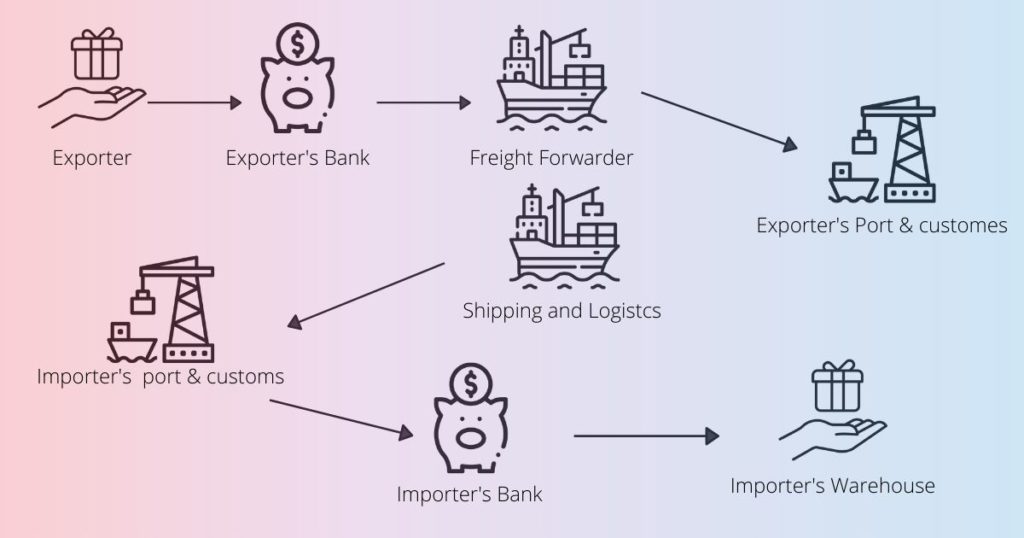
Now, in this entire process, at every stage, a lot of documentation is needed. While each and every process is handled by different parties involved in it, discrepancies and change in the document or goods are quite possible. This leads to a lot of confusion in the system and therefore wastage of time and reduced transparency.
Then, how can a digital ledger, or Blockchain, save this?
Blockchain + Logistics Industry
Blockchain is a distributed ledger system that records transactions between nodes in a secure and permanent block. In layman’s terms, Blockchain is a digital ledger that shares databases between end-users and removes the dependencies of agencies working in between those gaps, where a breach is possible. As both the end-users have the power to validate the data, a complete end to end process is both trustworthy and reliable.
While Blockchain is leading us to a BFSI revolution by cutting the traditional cost of money transfers and ability to do micro transfers, in Logistics, Blockchain gives power to the consumers to make their buying decisions about the products they want to buy. Here are the benefits of Using Blockchain into the logistics system:
With blockchain, logistics contracts can implement smart contracts for each batch of their shipping goods. For example, if someone using logistical software and integrate a smart contract, they would be able to add access points where the data would get calibrated and checked by automated system checkers. If all the items are going good and system passes the test, smart contracts would validate it and let the further process go ahead including payments and handing over the goods to the user at the other end.
What Blockchain would bring to the table for logistics?
Efficiency
Not only the final supply chain, but Blockchain-based ledger would also be able to give all the data about insurance, brokerage, legal documentation and shipping services. Blockchain can be used to track the entire product life-cycle and goods’ ownership change from the supplying to receiving authorities. This not only increases the relationship between the supplier and the end participant.
Blockchain helps to trace all the legal and payment transactions within the process, which ultimately increase the efficiency of the system.
Transparency
Logistics is an integral part of the supply chain management systems, when we talk about the transparency, entire picture becomes bigger for every industry and end-user associated with it. Organizations across the globe are adopting blockchain technology in their supply chain system.
As blockchain is a digital ledger, it keeps track of every transaction taking place from the beginning of sourcing the items, manufacturing and shipping. The end-user would be able to track the flow and can analyse the data about the product they are purchasing.
Empowers modern businesses
Minor updates in manufacturing patterns, transport operators, warehousing agents, retailers and last-mile delivery, everything can be traced into the virtual ledger. This means, using Blockchain-based virtual currencies can be used for payment transactions across the countries.
With Blockchain, digital identities and tamper-proof documentation can be maintained. Which gives power to the digitally transformed businesses to take advantage of this technology.
Smart contracts
As we saw that there is a lot of manual documentation and process involved in handling logistics of the goods, a smart contract developed by Blockchain can come to the rescue. You can simply build smart contracts that would guide the entire process of handling payments, legal contracts & documentation with self-executing and authorizing processes.
They would be created by involving each stakeholder’s agreed rules and process stages to improve the entire process.
Security
Unlike traditional ledgers, Blockchain-based virtual ledgers would provide more security against any data breaches or involved parties would not be able to make any changes in the system.
Also, Blockchain allows single-point access to check the ledger, all the stakeholders would be able to see the transaction and processes. That increases security and transparency!
So, overall, already a technically focused industry getting even better by implementing blockchain is a win-win situation for everyone. Also, if the logistic industry works well, all the end users would benefit out of it. For a broader impact, Blockchain adoption is the way to go.
The post Blockchain for Logistic Industry appeared first on Adrixus.
]]>